
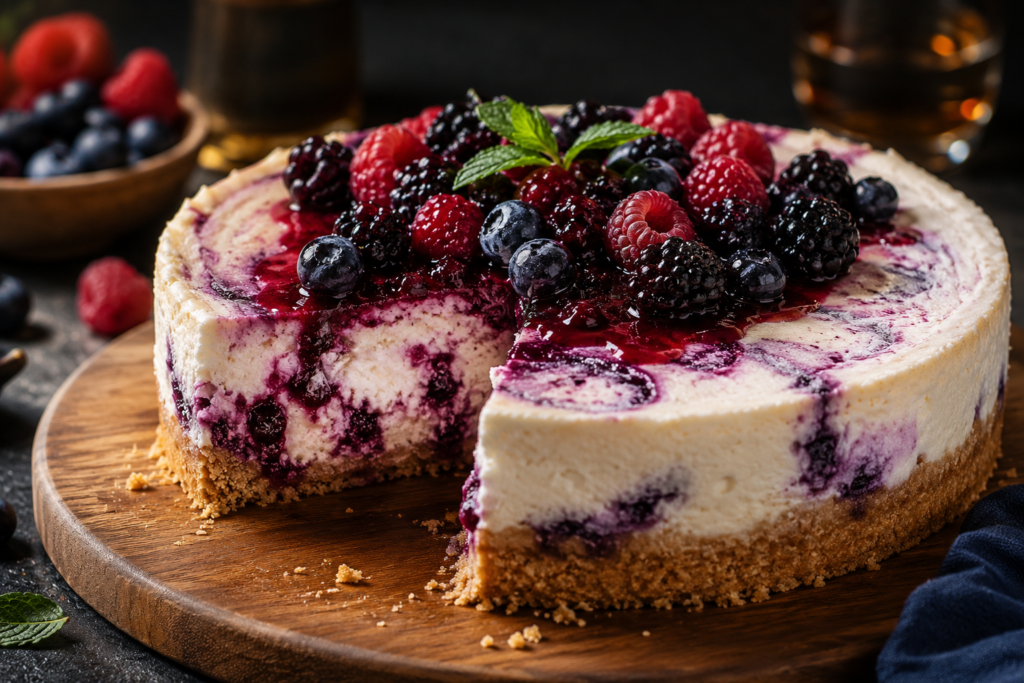
Most cheesecake in North America is built on cream cheese — dense, rich, and unmistakably New York in style. But cheesecake has a much older lineage in Italy, particularly Sicily, where ricotta has always been the base. Berry ricotta cheesecake brings that tradition forward: a lighter filling that’s less heavy than the standard cream cheese version, finished with fresh berries and a dusting of confectioner’s sugar that play beautifully against ricotta’s mild, milky flavour.
As a pastry chef, the questions I hear most about this dessert fall into two camps — is it actually healthier than the classic version, and is there a “real” traditional recipe worth following instead of just swapping ricotta into a standard cheesecake formula. This guide answers both, then walks you through building one from scratch using our precise tested proportions.
Key Takeaways
- Ricotta cheesecake and cream cheese cheesecake aren’t interchangeable — the texture, sweetness, and structure are genuinely different, not just a substitution.
- Ricotta is measurably lower in calories and fat than full-fat cream cheese, so the health difference is real, not just marketing.
- Traditional Sicilian ricotta cheesecake leans on the ricotta’s own unique texture, while this hybrid adaptation combines it with Neufchâtel for a foolproof balance.
- The same mixing and baking mistakes that wreck a standard cheesecake apply here too, particularly regarding temperature control and cooling.
- Full recipe details, precise yields, and a reader-question FAQ are below.
How Is Ricotta Cheesecake Different from Regular Cheesecake?
The difference starts with texture. Cream cheese cheesecake is dense, smooth, and holds a clean slice. Ricotta cheesecake is lighter and slightly grainy, with more moisture, because ricotta itself is a fresh, unripened whey cheese rather than a fermented, thickened one. The flavour shifts too — ricotta is milder and less tangy than cream cheese, so a ricotta cheesecake reads as less rich and a bit more like a custard than a dense bar.
Structurally, traditional Italian and Sicilian versions often go further than just swapping the cheese. Many authentic recipes skip heavy additions, relying on the ricotta’s own body to hold its shape, sometimes with a thin pastry base instead. That’s the biggest gap between “ricotta cheesecake” as a North American variation and the traditional Sicilian version people are often actually asking about — the traditional version is closer to a baked cheese custard than a dense American cheesecake.
Is Ricotta Cheesecake Actually Healthier?
Per 100 grams, standard cream cheese runs around 350 calories and 34 grams of fat, compared to ricotta’s roughly 156 calories and 10 grams of fat — and using reduced-fat cream cheese (Neufchâtel) in our blend lowers the overall density even further. Ricotta also comes out ahead on protein and calcium, offering around 11 grams of protein and 240 mg of calcium per 100 grams versus cream cheese’s roughly 6 grams of protein and 97 mg of calcium. So yes, gram for gram, ricotta genuinely is the lighter, more nutrient-dense option.
That said, a full ricotta cheesecake still contains sugar, eggs, and half-and-half, so it’s not a “diet” dessert — just a comparatively lighter one. As for cheesecake being “the unhealthiest dessert in the world,” that’s an exaggeration; it’s calorie-dense per slice like most rich baked desserts, but no more extreme than a slice of layered cake with buttercream once portion size is accounted for. Whether you’ll gain weight from eating it comes down to how much and how often, the same as with any dessert.
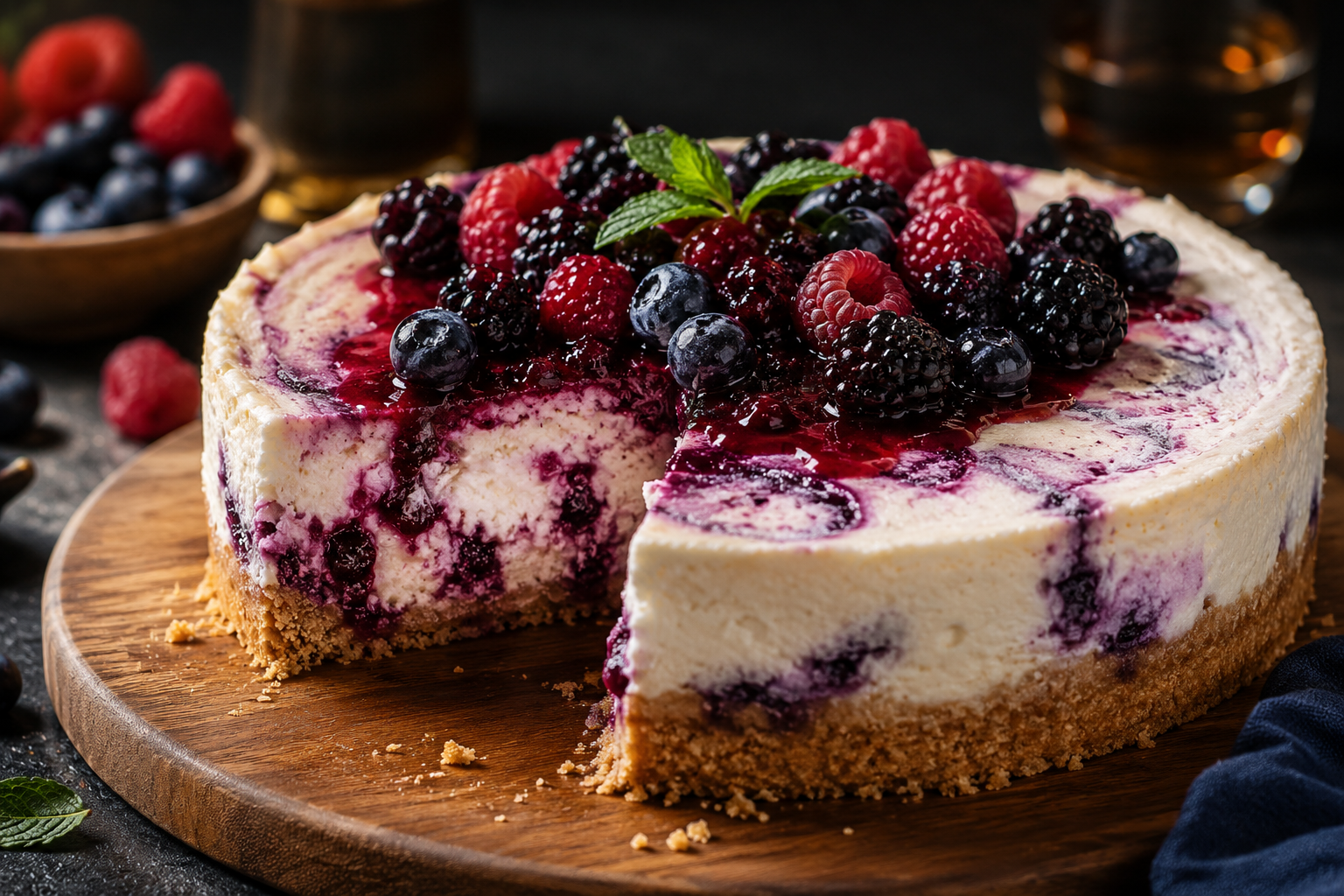
Berry Ricotta Cheesecake
Ingredients
Method
- Prep the Oven & Pan: Preheat oven to 375 degrees Fahrenheit (190°C). Cover the exterior part of a nine-inch springform pan with heavy-duty foil to prevent leakage, then spray the inside lightly with cooking spray.
- Make the Crust: Combine the graham cracker crumbs, 6 tablespoons of melted butter, and 1 tablespoon of granulated sugar in a medium bowl. Press the mixture firmly onto the bottom of the prepared springform pan.
- Bake the Crust: Bake the crust for 8–10 minutes until the edge is lightly browned. Let it cool on a wire rack. Reduce oven temperature to 325 degrees Fahrenheit (163°C).
- Prep the Lemons: Meanwhile, grate 1 tablespoon of lemon peel (zest) and squeeze out at least one-fourth cup of fresh lemon juice; set both aside.
- Beat the Cheeses: In the bowl of an electric mixer, beat the ricotta cheese and the reduced-fat cream cheese on high speed until completely smooth.
- Add Dry Ingredients: Beat in the cornstarch, 1/4 teaspoon salt, and 1 1/2 cups of granulated sugar. Scrape the sides of the bowl down with a rubber spatula, then continue beating on low speed until fully blended.
- Incorporate Liquids & Eggs: Add the half-and-half, almond extract, and vanilla extract, beating on low speed. Mix in the fresh lemon juice and lemon peel. Finally, beat in the eggs one by one until all ingredients are blended well.
- Bake: Fill the prepared crust with the batter and bake for one hour. Turn off the oven and leave the cake standing inside the closed oven for one additional hour to cool down gradually.
- Loosen & Chill: Loosen the edge of the cake by carefully running a thin knife around the inside of the pan. Cool on a pan rack for one hour before covering and placing in the refrigerator for at least six hours (and up to two days).
- Garnish & Serve: Just before serving, spread the mixed berries evenly on top of the cheesecake. Dust the confectioner’s sugar over the berries through a fine sieve. Slice and serve!
Frequently Asked Questions
- Is ricotta cheesecake healthier than cream cheese cheesecake? Yes — ricotta is measurably lower in calories and fat and higher in protein and calcium than full-fat cream cheese, and combining it with reduced-fat Neufchâtel lightens the profile further.
- Why do we cover the springform pan in foil? Because the batter contains liquid dairy like half-and-half and ricotta, a foil wrap protects the bottom from water leaks if you use a water bath, or simply catches any butter seeping from the crust during baking.
- What is the purpose of leaving the cake in the turned-off oven? It prevents sudden temperature drops, which cause the delicate custard structure to sink or crack in the center.
- Can I prepare this in advance? Yes, keeping it chilled in the refrigerator for anywhere from 6 hours up to 2 days actually improves the texture and allows the flavors to meld completely.
- What are common cheesecake mistakes to avoid? Overmixing the batter after adding the eggs, shocking the cake with sudden cold air when removing it from the oven, and skipping the chill time.
- Will I gain weight if I eat cheesecake? Not from a single slice — like any rich dessert, the impact comes down to overall portion size and frequency, not the dessert itself.
Final Thoughts
Berry ricotta cheesecake isn’t just a lighter substitute for the classic version — it’s a genuinely different dessert with its own tradition, texture, and refined flavour profile from the lemon, almond, and fresh berries.
Give it a try this week, and if your filling gives you any trouble or you have questions about the crust, leave a comment — I’ll help you troubleshoot exactly where it went off track.