Strawberry Cheesecake: A Pastry Chef’s Guide to Getting It Simple and Right

Strawberry Cheesecake

Strawberry cheesecake is one of those desserts everyone assumes is complicated — springform pans, water baths, the fear of a cracked top ruining the whole thing. It doesn’t need to be. Underneath the fancy presentation, a good strawberry cheesecake comes down to a short list of ingredients and a handful of technique choices, done in the right order. It’s a staple at bakeries across Toronto for a reason: it’s rich without being heavy, and the strawberry topping keeps it feeling seasonal rather than dense and one-note.

As a pastry chef, the questions I hear most about this dessert aren’t about flavour — they’re about simplicity and troubleshooting. Can you really make cheesecake with three or four ingredients? What’s actually going wrong when it cracks? Is there a real “secret” to a perfect one, or is that just marketing? This guide answers all of it, then gives you a full recipe to work from.

Key Takeaways

  • A genuinely simple, few-ingredient cheesecake is possible — but “simple” changes the texture, and it’s worth knowing what you’re trading away.
  • Almost every cheesecake mistake traces back to one of three things: overmixing, oven temperature, or cooling too fast.
  • Underbaking slightly, not overbaking, is the safer target — cheesecake finishes setting as it cools.
  • Cheesecake isn’t automatically the “unhealthiest” dessert on a menu; that reputation is more about portion size than the dessert itself.
  • Full recipe and an FAQ built from real reader questions are below.

What’s the Best Recipe for Strawberry Cheesecake?

There isn’t a single “best” recipe so much as a best recipe for what you’re trying to achieve. A classic baked New York-style cheesecake — cream cheese, sugar, eggs, sour cream, baked slow in a water bath — gives you the dense, sliceable texture most people picture. A no-bake version, built on whipped cream or gelatin instead of eggs, gives you something lighter and quicker, at the cost of that same dense structure.

The “secret” people ask about usually isn’t a secret ingredient — it’s technique. Room-temperature cream cheese and eggs blend smoothly without lumps; cold ingredients don’t, no matter how long you beat them. That single detail solves more cheesecake problems than any specific brand of cream cheese or a particular pan.

Can You Really Make Cheesecake with 3 or 4 Ingredients?

Yes, and it’s a genuinely useful shortcut — but it’s worth knowing what you’re giving up. A minimal-ingredient cheesecake typically strips things down to cream cheese, sugar, eggs, and sometimes vanilla, skipping the sour cream, crust, or water bath entirely. What you get is a denser, more straightforward custard that’s closer to a baked cheesecake filling on its own than a full bakery-style slice. It’s a great option on a weeknight or when you don’t have a full pantry, but it won’t have the same silky, layered texture as a version built with sour cream and a proper crust.

If you want that stripped-down version to come out fluffier rather than dense, the fix isn’t adding more eggs — it’s beating the cream cheese and sugar together longer before adding eggs, and folding rather than stirring once they’re in. Overmixing after the eggs go in is actually the more common cause of a flat, heavy result.

What Are the Most Common Cheesecake Mistakes?

Nearly every cheesecake problem I get asked about comes down to one of three things:

  • Overmixing. Beating too much air into the batter, especially after the eggs are added, is the leading cause of cracks — the trapped air expands in the oven, then collapses as it cools, pulling the surface apart.
  • Baking temperature and time. Cheesecake is a custard, not a cake — it should still have a noticeable jiggle in the centre when you take it out. It’s better to underbake slightly than overbake; a slightly underdone centre firms up as it chills, while an overbaked one dries out and cracks.
  • Cooling too fast. A sudden temperature change — pulling a hot cheesecake straight into a cold fridge or a drafty kitchen — is what causes most late cracks, even in cheesecakes that baked perfectly. Letting it cool gradually in the oven with the door cracked open solves this almost every time.

As for whether cheesecake is “the unhealthiest cake” — it’s not a fair label. Cheesecake is calorie-dense per slice, but so are most layered cakes with buttercream once you compare realistic portion sizes. The reputation comes more from how rich a single slice feels than from any real nutritional gap between desserts.

The Recipe: Simple Baked Strawberry Cheesecake

Makes one 9-inch (23 cm) cheesecake, 12–14 slices.
Strawberry Cheesecake

Strawberry Cheesecake

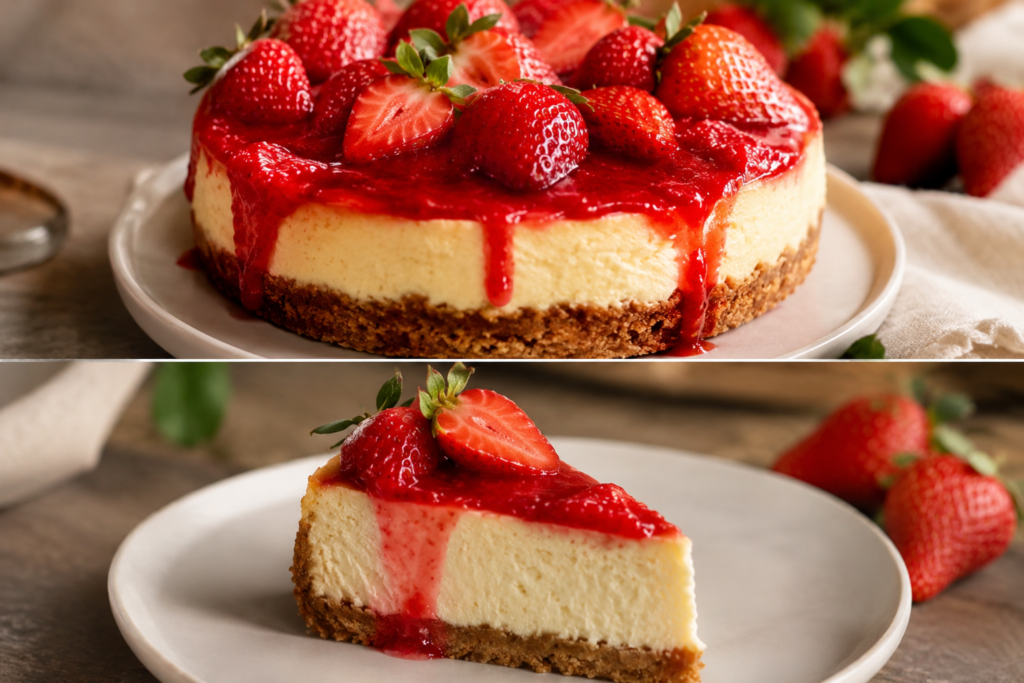
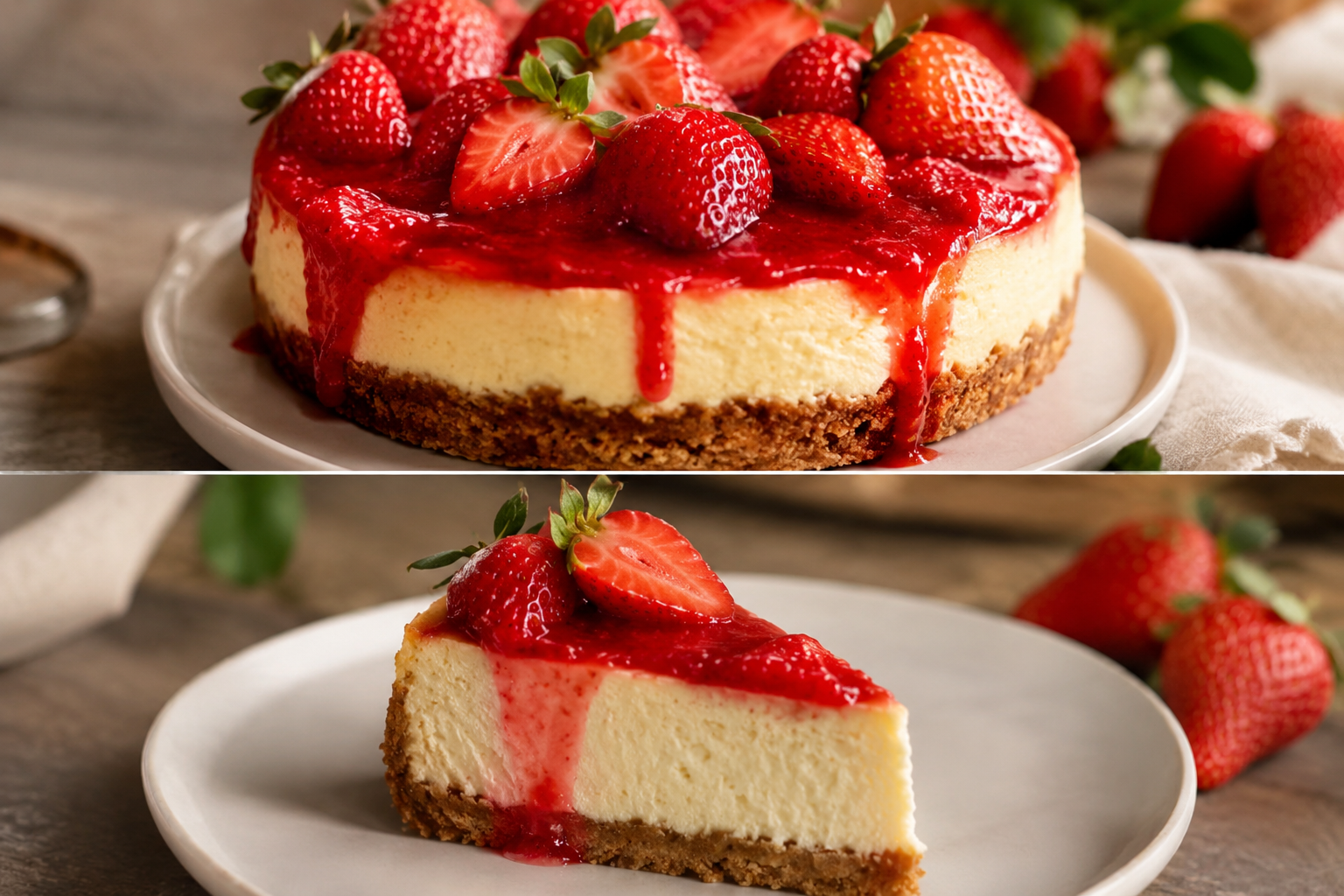
A classic baked cheesecake on a graham crust, topped with fresh strawberry sauce.
Total Time 1 hour 30 minutes
Servings: 12 Slices
Course: Dessert

Ingredients
  

For the crust:
  • 200 g about 2 cups graham cracker crumbs
  • 50 g ¼ cup granulated sugar
  • 115 g ½ cup unsalted butter, melted
For the cheesecake filling:
  • 900 g four 8 oz/226 g blocks full-fat cream cheese, at room temperature
  • 300 g 1½ cups granulated sugar
  • 240 mL 1 cup sour cream, at room temperature
  • 1 tsp vanilla extract
  • 4 large eggs at room temperature
For the strawberry topping:
  • 450 g about 3 cups fresh strawberries, hulled and halved
  • 100 g ½ cup granulated sugar
  • 15 mL 1 tbsp lemon juice
  • 1 tsp cornstarch mixed with 1 tbsp water

Equipment

  • Stand or hand mixer
  • Roasting pan
  • Saucepan
  • 9-inch Springform Pan
Method Strawberry Cheesecake
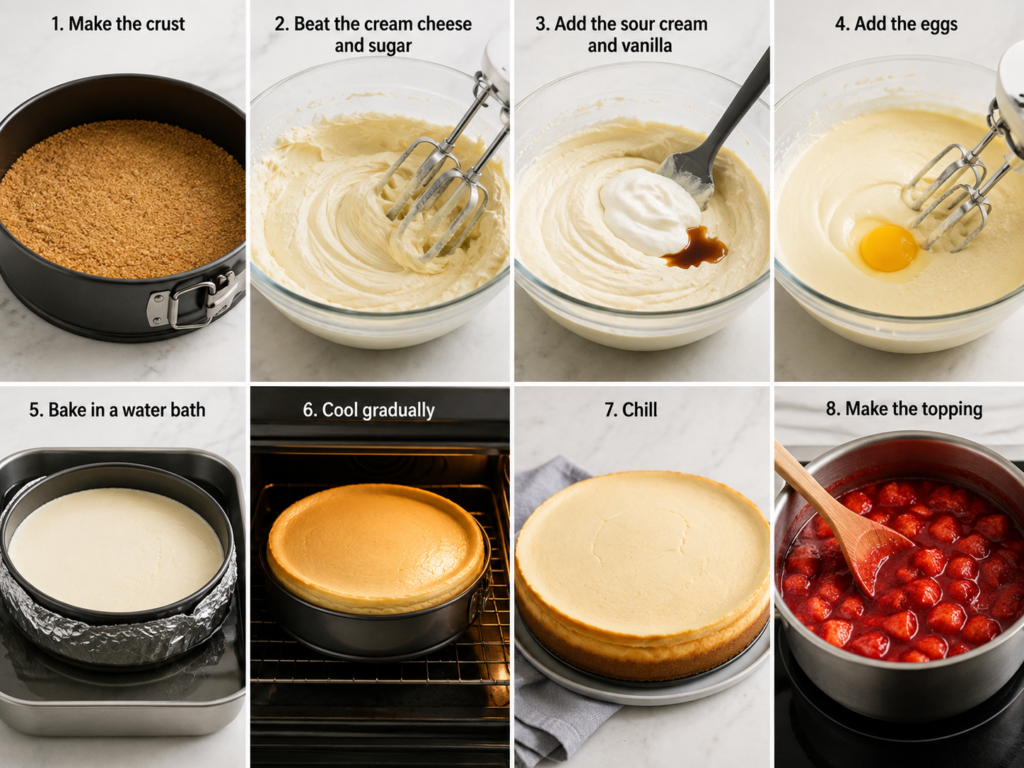
  1. Make the crust. Preheat the oven to 325°F (163°C). Combine the graham crumbs, sugar, and melted butter, then press firmly into the bottom of a 9-inch springform pan. Bake for 8–10 minutes, then set aside to cool.
  2. Beat the cream cheese and sugar. Using a stand or hand mixer, beat the room-temperature cream cheese and sugar on medium speed until completely smooth — this step matters more than any other for avoiding lumps.
  3. Add the sour cream and vanilla. Mix in just until combined.
  4. Add the eggs. Add eggs one at a time on low speed, mixing only until each one disappears into the batter. Stop as soon as the batter is smooth — this is the step most likely to cause cracks if overdone.
  5. Bake in a water bath. Wrap the outside of the springform pan in foil, set it in a larger roasting pan, and add hot water halfway up the sides. Bake for 55–65 minutes, until the edges are set and the centre still has a gentle jiggle.
  6. Cool gradually. Turn off the oven, crack the door open, and let the cheesecake sit inside for an hour before removing it. This slow cooldown is what prevents last-minute cracking.
  7. Chill. Refrigerate for at least 6 hours, ideally overnight.
  8. Make the topping. Combine strawberries, sugar, and lemon juice in a saucepan over medium heat. Simmer until the strawberries soften and release their juice, about 8 minutes. Stir in the cornstarch slurry and cook 1–2 more minutes, until thickened. Cool completely before spooning over the chilled cheesecake.

Frequently Asked Questions

What is the secret to making a good cheesecake?
Room-temperature ingredients and minimal mixing once the eggs are added — most texture problems trace back to one of those two things.

What are common cheesecake mistakes to avoid?
Overmixing the batter, overbaking past a slight centre jiggle, and cooling the cheesecake too quickly after it comes out of the oven.

What is the 3-ingredient cheesecake?
A stripped-down version using just cream cheese, sugar, and eggs, skipping the sour cream and crust for a denser, quicker result.

How do you make cheesecake with 4 ingredients?
Add vanilla extract to the 3-ingredient base — cream cheese, sugar, eggs, and vanilla — for a slightly more rounded flavour without adding complexity.

Is it better to overbake or underbake cheesecake?
Underbake slightly. Cheesecake continues to set as it cools, so a gentle jiggle in the centre when it comes out of the oven is exactly what you want.

How do you make super fluffy cheesecake?
Beat the cream cheese and sugar thoroughly before adding eggs, then fold rather than stir once they’re incorporated — overmixing at that stage flattens the texture.

Is cheesecake the unhealthiest cake?
Not really — it’s rich per slice, but comparable to most layered cakes with buttercream once you account for typical portion sizes.

Final Thoughts

Strawberry cheesecake has a reputation for being finicky that it doesn’t fully deserve. Once you understand that most problems come down to mixing, temperature, and cooling speed — not a missing secret ingredient — it becomes one of the more forgiving desserts to bake well. Start with the full recipe above, or strip it down to a simple 3- or 4-ingredient version on a night when you want something quick.

Try it this week, and if you run into cracks or a filling that won’t set, leave a comment — I’ll help you figure out exactly which step to adjust.
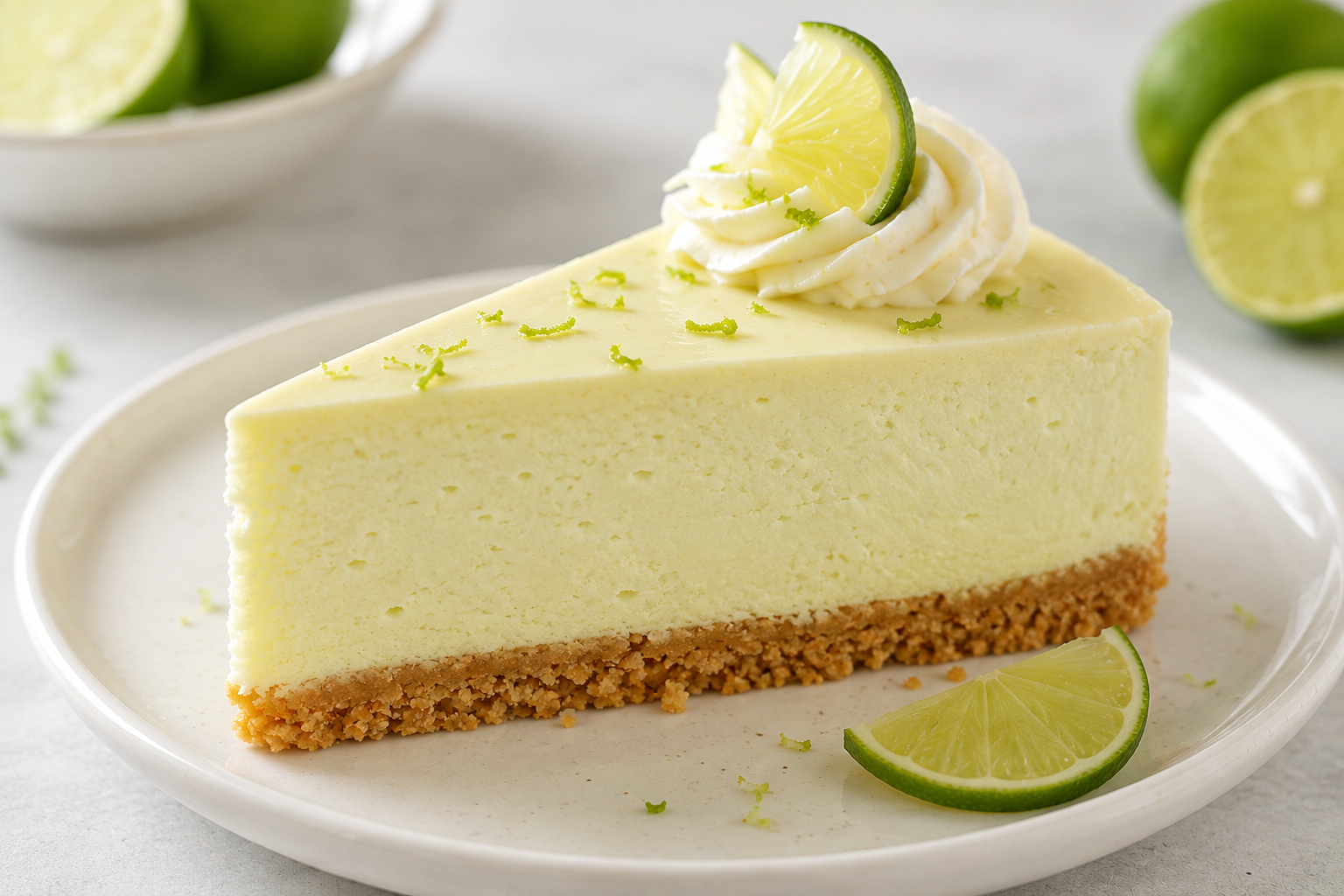
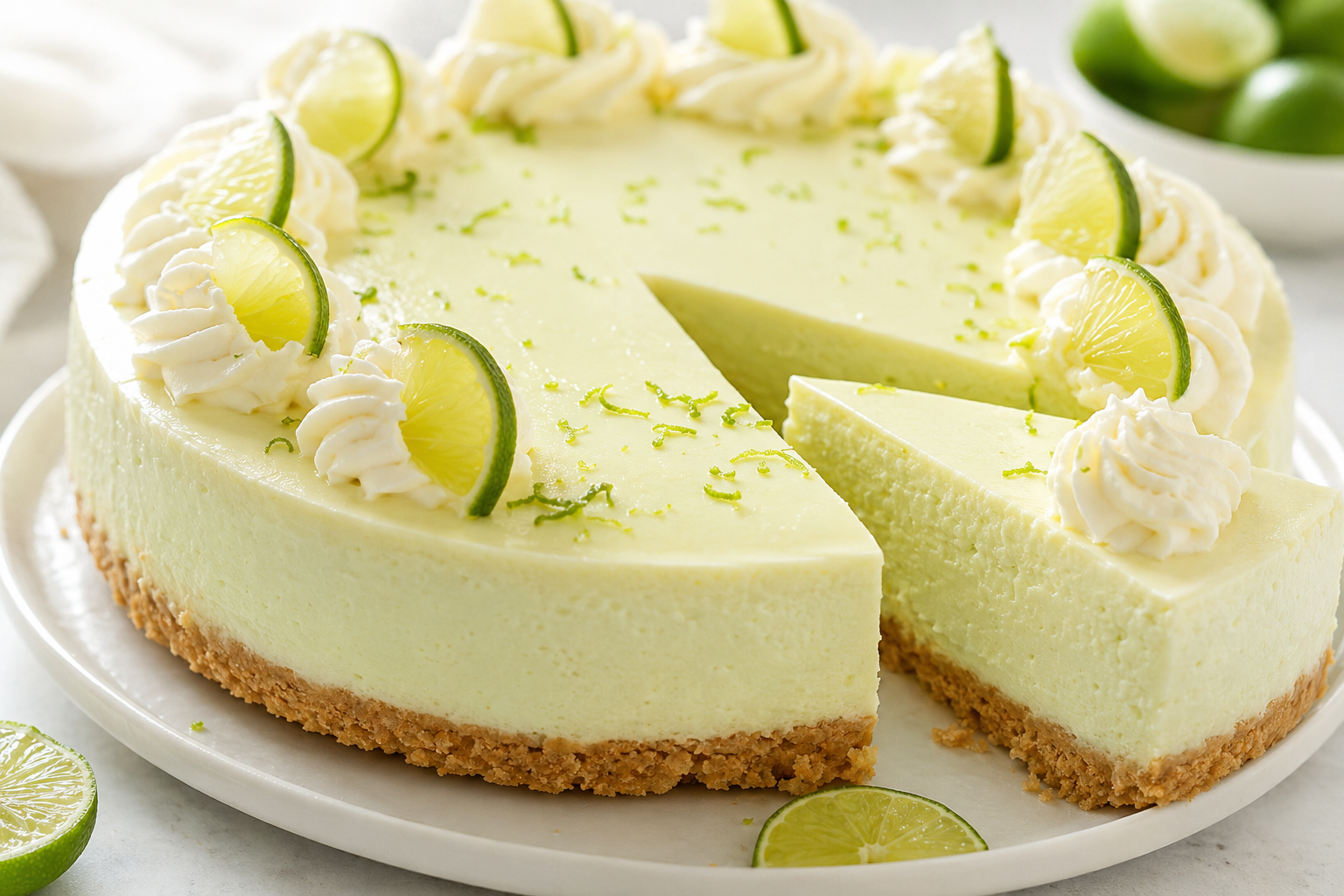
Key Lime Cheesecake: A Pastry Chef’s Guide to Getting the Tart-and-Creamy Balance Right

KEY LIME CHEESECAKE
KEY LIME CHEESECAKE

Key lime pie has a loyal following, and cheesecake has an even bigger one — so it was only a matter of time before someone put the two in the same dessert. Key lime cheesecake takes the sharp, citrusy punch of Key lime and folds it into a dense, creamy cheesecake base, usually over a graham cracker crust that echoes the original pie. It’s become a regular request in Canadian bakeries during the summer months, when people want something rich but still bright and refreshing.

As a pastry chef, the questions I get about this dessert are fairly consistent — what actually separates it from Key lime pie, whether it’s a “real” thing or just a novelty, what cream cheese does to the texture, and which version to order if you’re at a restaurant. This guide walks through all of it, then gives you a full recipe to build your own.

Key Takeaways

  • Key lime pie and Key lime cheesecake share the same flavour base but differ completely in texture, structure, and how they’re baked.
  • Key lime cheesecake is a legitimate, established dessert — including a well-known Basque-style version — not just a marketing mashup.
  • Adding cream cheese to a Key lime pie recipe changes it into a different dessert entirely rather than just “improving” the original.
  • The most common mistakes with Key lime desserts come down to juice substitution and overbaking, not the recipe itself.
  • Full recipe and an FAQ pulled straight from real reader questions are below.

What Actually Separates Key Lime Pie from Key Lime Cheesecake?

The flavour profile is nearly identical — both rely on Key lime juice, which is more floral and slightly less acidic than standard Persian lime juice, along with sweetened condensed milk in most traditional recipes. The difference is structural. Key lime pie is a custard: eggs, condensed milk, and lime juice baked into a single thin layer inside a crust, typically no more than an inch deep. Key lime cheesecake is a cream cheese-based filling, several inches thick, baked low and slow, often in a water bath to prevent cracking.

That structural difference changes the eating experience more than people expect. Pie is light and sets almost like a mousse; cheesecake is dense and holds its shape on a fork. If you’re deciding which is “healthier,” neither one has a real advantage — pie generally uses less fat overall, but cheesecake’s larger cream cheese content isn’t dramatically worse once you compare typical slice sizes. The gap is smaller than most people assume.

Is Key Lime Cheesecake Actually a Real Thing?

Yes — and it’s more established than people realize. Beyond the standard baked version, there’s a well-known Basque-style Key lime cheesecake, which uses the crustless, deliberately over-browned technique that’s become popular over the last several years. That style leans into a slightly burnt top and a looser, almost molten centre, which pairs surprisingly well with Key lime’s acidity cutting through the richness.

As for the naming — “Key lime” specifically refers to the smaller, more aromatic lime variety grown in the Florida Keys, not just a branding choice. It’s genuinely a different fruit from the limes sold in most Canadian grocery stores, which is why so many recipes call for bottled Key lime juice; fresh Key limes can be hard to source outside specialty stores.

What Does Adding Cream Cheese to Key Lime Pie Actually Do?

This is less “improving the pie” and more “creating a different dessert.” Once you add a meaningful amount of cream cheese to a traditional Key lime pie filling, you’re no longer making a custard — you’re making a cheesecake with pie proportions. The texture shifts from light and jiggly to dense and rich, and the tartness gets slightly muted because cream cheese carries its own mild tang that competes with the lime rather than amplifying it.

If your goal is a fluffier result rather than a denser one, the fix isn’t more cream cheese — it’s whipped egg whites folded in gently, or using room-temperature ingredients so the batter incorporates air properly. The most common mistake I see is using bottled lime juice that isn’t labelled specifically as Key lime, which throws off the acidity balance the recipe was built around. The second most common mistake is overbaking: both pie and cheesecake versions should still have a slight wobble in the centre when you pull them from the oven — they finish setting as they cool.

What’s the Best Version to Order at a Restaurant?

Across cheesecake rankings and restaurant reporting, classic strawberry remains the single best-selling cheesecake flavour at chains like The Cheesecake Factory, a title it’s held for more than four decades — so if you’re ordering the safest bet, that’s usually it, not the Key lime specifically. That said, Key lime and its mango-key-lime variation do show up on 2026 chain rankings among the flavours worth trying, and reviewer opinions on it are genuinely mixed rather than universally positive — some praise its brightness, others find it too tart for a cheesecake format. If citrus desserts aren’t usually your first choice at a restaurant, it’s worth ordering as a split slice before committing to a full piece.

The Recipe: Layered Key Lime Cheesecake with Lime Custard & Sour Cream Topping

This version builds in three distinct layers — a cooked Key lime custard on the bottom, a cream cheese filling over top, and a sour cream topping baked on at the end — for a cheesecake that’s noticeably more citrus-forward than a standard single-batter version. Makes one 9-inch (23 cm) cheesecake, 12–14 slices.

KEY LIME CHEESECAKE

KEY LIME CHEESECAKE

A 9-inch cheesecake built in three distinct layers: a cooked Key lime custard on the bottom, a cream cheese filling spooned over it, and a sweetened sour cream topping baked on at the very end. It sits on a graham cracker crust and bakes in a water bath for a smooth, crack-free texture. The result is a citrus-forward cheesecake with more depth than a standard single-batter version — tangy custard base, rich creamy middle, and a light tart topping. Chills overnight and finishes with fresh lime slices.
Servings: 12 slices
Course: Dessert

Ingredients
  

For the Key lime custard
  • 6 large egg yolks
  • 150 g ¾ cup sugar
  • 90 mL 6 tbsp fresh Key lime juice
  • 1 tsp grated Key lime peel
For the crust
  • 175 g 1¾ cups graham cracker crumbs
  • 50 g ¼ cup sugar
  • ½ tsp salt
  • 115 g ½ cup unsalted butter, melted
For the cheesecake filling
  • 450 g two 8 oz/226 g packages cream cheese, at room temperature
  • 135 g ⅔ cup sugar, plus 3 tbsp reserved for the topping
  • 2 large eggs
  • 45 mL 3 tbsp fresh Key lime juice
  • 1 tbsp grated Key lime peel
  • 1 container 450 g/16 oz sour cream
To garnish: fresh lime slices

Equipment

  • Large saucepan for cooking the Key lime custard
  • Whisk to combine and stir the custard while it thickens
  • Zester or fine grater for the Key lime peel
  • Citrus juicer for the fresh Key lime juice
  • 2 Large mixing bowl one for the crust mixture, one for the cream cheese filling
key lime cheesecake
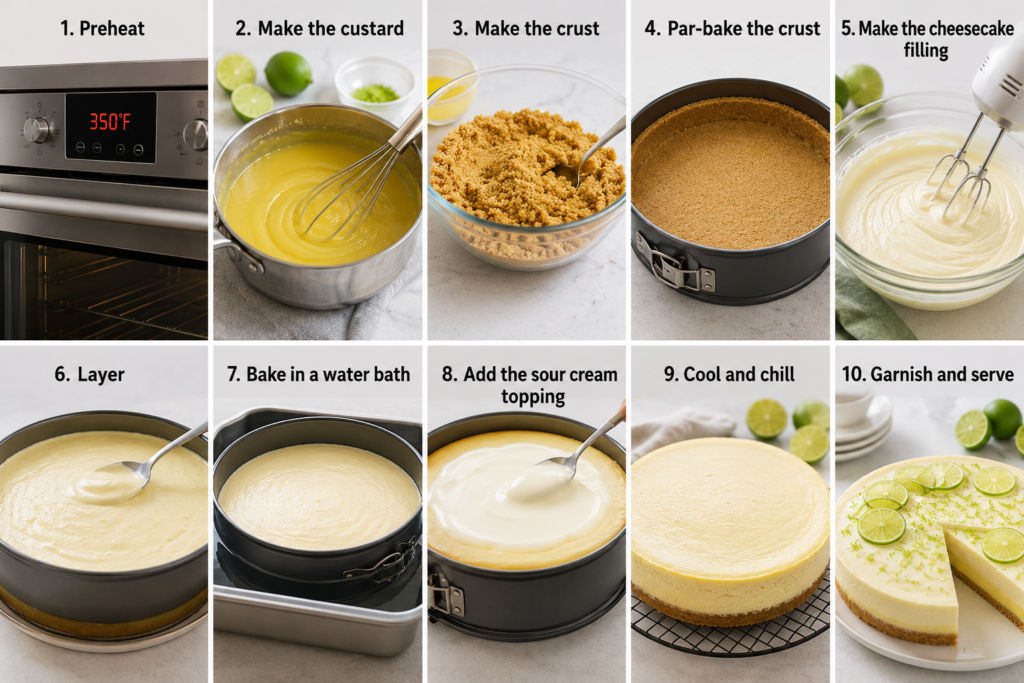
  1. Preheat. Set the oven to 350°F (177°C).
  2. Make the custard. In a large saucepan over medium heat, whisk together the egg yolks, sugar, Key lime juice, and lime peel. Bring to a boil, stirring continuously, then reduce the heat and cook for 8 more minutes, until the mixture thickens into a custard. Remove from heat and let cool to room temperature.
  3. Make the crust. In a large bowl, combine the graham cracker crumbs, sugar, salt, and melted butter. Press into the bottom and about 1 inch (2.5 cm) up the sides of a 9-inch springform pan.
  4. Par-bake the crust. Bake for 5 minutes, then remove from the oven.
  5. Make the cheesecake filling. Beat together the cream cheese, ⅔ cup (135 g) sugar, eggs, Key lime juice, and lime peel until smooth and creamy.
  6. Layer. Spoon the cooled custard into the crust and spread it into an even layer. Carefully spoon the cream cheese filling over top, smoothing gently so the layers stay distinct.
  7. Bake in a water bath. Set the springform pan into a larger baking pan and add hot water until it comes 1 inch (2.5 cm) up the sides. Bake for 45 minutes, until the centre is almost set.
  8. Add the sour cream topping. While the cheesecake bakes, stir together the sour cream and the remaining 3 tablespoons of sugar. Once the 45 minutes are up, spoon the mixture over the hot cheesecake and return it to the oven for another 10 minutes.
  9. Cool and chill. Let the cheesecake cool completely, then cover and refrigerate until fully set — at least 6 hours, ideally overnight.
  10. Garnish and serve. Top with fresh lime slices just before slicing.

Frequently Asked Questions

How is Key lime pie different from cheesecake?
Pie is a thin egg-and-condensed-milk custard baked into a crust, while cheesecake is a much thicker cream cheese filling, usually baked in a water bath — same core flavour, different structure entirely.

Which is healthier, cheesecake or Key lime pie?
Neither has a clear advantage. Pie tends to use less fat overall, but the gap narrows once you compare realistic slice sizes.

Is Key lime cheesecake just lime cheesecake?
No — Key limes are a distinct, more aromatic fruit from the ones typically sold in Canadian grocery stores, which is why most recipes specifically call for Key lime juice.

What is Key lime Basque cheesecake?
It’s a crustless, deliberately over-browned cheesecake style with a soft, almost molten centre, adapted here with Key lime juice cutting through the richness.

Is Key lime pie better with cream cheese?
It’s not strictly “better” — adding cream cheese turns it into a different dessert (a cheesecake) rather than an upgraded version of the original pie.

What are common mistakes when making Key lime pie or cheesecake?
Using regular lime juice instead of Key lime juice, and overbaking past the point where the centre should still have a slight wobble.

How do you make Key lime pie fluffier?
Fold in whipped egg whites and use room-temperature ingredients so the batter holds air properly — adding more cream cheese will make it denser, not fluffier.

Final Thoughts

Key lime cheesecake isn’t a shortcut version of the pie — it’s its own dessert, built on the same bright, floral lime flavour but with a completely different texture and technique. Whether you’re after the dense, classic baked version above or want to try the Basque-style approach next, the fundamentals stay the same: real Key lime juice, room-temperature ingredients, and a gentle hand with the mixer.

Give the recipe a try this week, and if your centre cracks or your filling comes out too tart or too sweet, leave a comment — I’ll help you dial it in before your next bake.

Carrot Cake Cheesecake: A Pastry Chef’s Guide

Carrot cheesecake

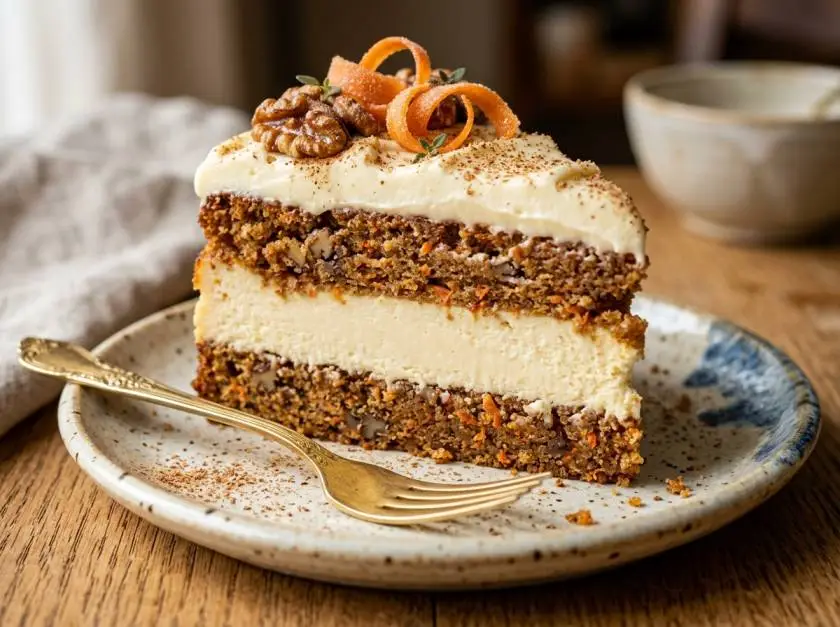
Carrot cake or cheesecake? For years, that question ended in a stalemate at dinner tables across Canada — until someone finally stopped choosing and started layering. Carrot cake cheesecake takes the warm, spiced comfort of carrot cake and marries it to the dense, tangy richness of New York-style cheesecake, usually finished with a swoop of cream cheese frosting. It’s not a gimmick. Done properly, it’s one of the most well-balanced desserts you can put on a Thanksgiving or Easter table, and it’s become a regular request at bakeries from Vancouver to Halifax.

As a pastry chef, I get asked about this dessert constantly — is it actually good, can you make it without an oven, does the frosting really belong on top, and what happened to the version restaurants used to serve. This guide answers all of it, then walks you through building your own from scratch.

Key Takeaways

  • Carrot cake cheesecake works because the tartness of the cheesecake layer cuts the sweetness of the spiced cake — they balance each other rather than compete.
  • It’s not automatically “healthier” or “unhealthier” than a standard slice of either dessert; portion size and frosting quantity matter more than which dessert it started as.
  • A no-bake version is absolutely possible, but it changes the texture of the cheesecake layer, and there are a few mistakes that ruin it every time.
  • Cream cheese frosting isn’t optional — it’s the ingredient that ties both layers together, both structurally and in flavour.
  • Full recipe and troubleshooting FAQ are below, sized for a standard 9-inch springform pan.

Is Carrot Cake Cheesecake Actually Good?

Short answer: when it’s made correctly, yes — noticeably better than either dessert on its own. The reason comes down to contrast. Carrot cake leans sweet and spiced, with cinnamon, nutmeg, and often crushed pineapple or shredded coconut adding moisture. Cheesecake, on the other hand, is tangy and dense from cream cheese and sour cream. Stacked together, the cheesecake layer stops the cake from tasting one-note sweet, and the cake keeps the cheesecake from feeling heavy. That balance is exactly why the combination has staying power rather than being a passing trend.

You’ll sometimes see carrot cake nicknamed “divorce cake” online. The name isn’t about the dessert itself — it’s an internet joke referencing an old news story where a couple’s divorce settlement famously came down to fighting over a carrot cake recipe. It has nothing to do with the cake’s ingredients or quality; it’s just a name that stuck.

As for which is “healthier,” neither carrot cake nor cheesecake earns that label in a meaningful sense. Carrot cake often carries a health halo because of the vegetable in its name, but a slice can carry as much sugar and fat as cheesecake once you account for oil, sugar, and cream cheese frosting. If you’re comparing the two, look at portion size and frosting thickness before you look at which one has carrots in it.

Can You Make a No-Bake Version?

Yes, and for home bakers without a lot of oven space — or in the middle of a Canadian summer when you don’t want to run the oven — this is often the better route. A no-bake cheesecake layer relies on gelatin or a high ratio of whipped cream and cream cheese to set, rather than eggs and heat. The carrot cake layer, however, still needs to be baked separately; there’s no way around that, since raw cake batter won’t set without heat.

The texture difference is real: a baked cheesecake layer is denser and slightly firmer, while a no-bake layer is lighter and mousse-like. Neither is “better” — it’s a matter of preference. The most common mistakes I see with no-bake versions are under-chilling (give it a minimum of six hours, ideally overnight) and using low-fat cream cheese, which won’t set properly. Stick to full-fat, block-style cream cheese, not the spreadable tub kind, and you’ll avoid the runny-middle problem that trips up most first attempts.

Does Cream Cheese Frosting Belong on Carrot Cake?

Unambiguously yes — it’s traditional, not optional. Carrot cake’s spice profile needs the tang of cream cheese frosting to cut through the sweetness; a plain buttercream leaves the cake tasting flat. The secret to getting it right is temperature and ratio: your cream cheese and butter both need to be properly softened (not melted) before creaming, and you want roughly equal parts cream cheese to butter so the frosting holds its shape without weeping. The most common carrot cake mistake isn’t the cake at all — it’s frosting a cake that hasn’t fully cooled, which melts the frosting into the crumb instead of sitting on top of it.

What About the Restaurant Version?

If you’ve had carrot cake cheesecake at a chain restaurant, availability tends to shift by season and location rather than disappearing outright — dessert menus rotate more often than people expect, and a favourite can vanish from one location while still running at another. If you’re chasing a specific restaurant version, your best bet is calling ahead or checking the current menu directly, since these things change throughout the year. The good news is that a homemade version, done well, holds up against any restaurant plate.

The Recipe: Swirled Carrot Cake Cheesecake with Pineapple, Coconut & Walnuts

This is the version I actually recommend to home bakers who want something closer to a true swirl than a stacked layer cake — the cheesecake batter is dropped straight into the carrot cake batter and marbled together in one pan, then finished with a pineapple-spiked cream cheese frosting. Makes one 9-inch (23 cm) springform cake, 12–14 slices.

Carrot CheeseCake

Carrot Cake Cheesecake

Carrot Cake Cheesecake combines moist, spiced carrot cake with creamy, tangy cheesecake and classic cream cheese frosting. This guide covers the key techniques, a complete baked recipe, no-bake options, common mistakes, and helpful FAQs.
Servings: 12 Slices
Course: Dessert

Ingredients
  

For the cheesecake batter
  • 450 g 16 oz cream cheese, at room temperature
  • 150 g ¾ cup sugar
  • tsp vanilla extract
  • 1 tbsp flour
  • 3 eggs
For the carrot cake batter
  • 180 mL ¾ cup vegetable oil
  • 200 g 1 cup sugar
  • 2 eggs
  • tsp vanilla extract
  • 125 g 1 cup flour
  • 1 tsp baking soda
  • tsp ground cinnamon
  • 1 tsp ground nutmeg
  • ½ tsp ground ginger
  • 227 g 8 oz can crushed pineapple in 100% juice, drained well — reserve the juice
  • 100 g 1 cup grated carrots
  • 40 g ½ cup shredded coconut
  • 50 g ½ cup chopped walnuts
For the pineapple cream cheese frosting
  • 60 g 2 oz cream cheese, softened
  • 1 tbsp butter softened
  • 220 g 1¾ cups icing sugar (confectioners’ sugar)
  • 1 tsp vanilla extract
  • 1 tbsp reserved pineapple juice

Equipment

  • Stand Mixer
  • 9-inch Springform Pan
  • Round Cake Pans
  • Wire Cooling Rack
Method Carrot Cheesecake
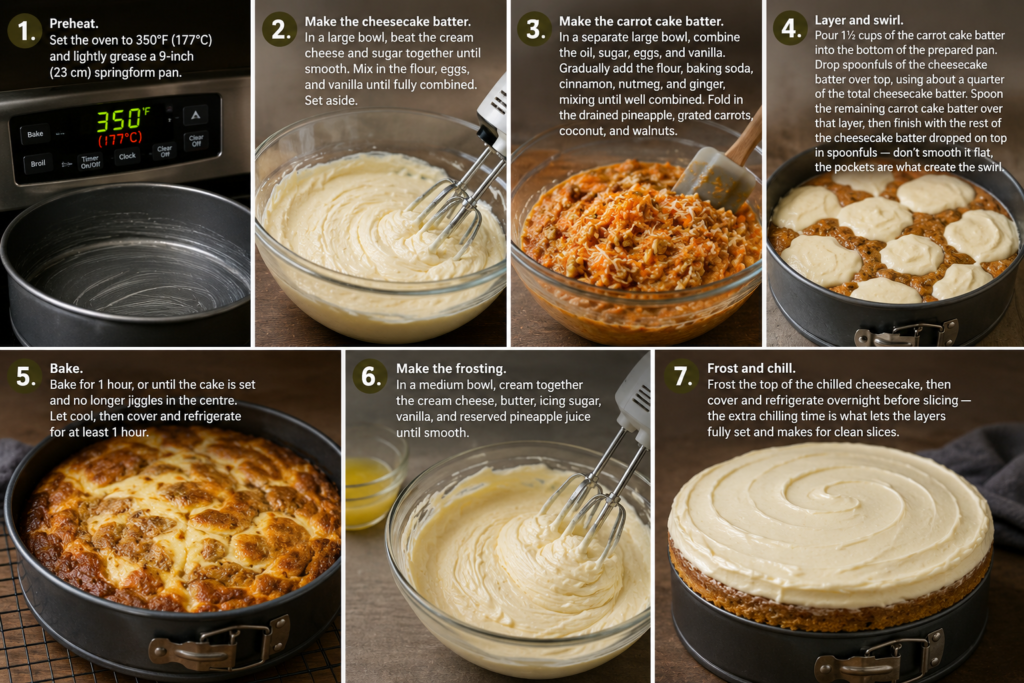
  1. Preheat. Set the oven to 350°F (177°C) and lightly grease a 9-inch (23 cm) springform pan.
  2. Make the cheesecake batter. In a large bowl, beat the cream cheese and sugar together until smooth. Mix in the flour, eggs, and vanilla until fully combined. Set aside.
  3. Make the carrot cake batter. In a separate large bowl, combine the oil, sugar, eggs, and vanilla. Gradually add the flour, baking soda, cinnamon, nutmeg, and ginger, mixing until well combined. Fold in the drained pineapple, grated carrots, coconut, and walnuts.
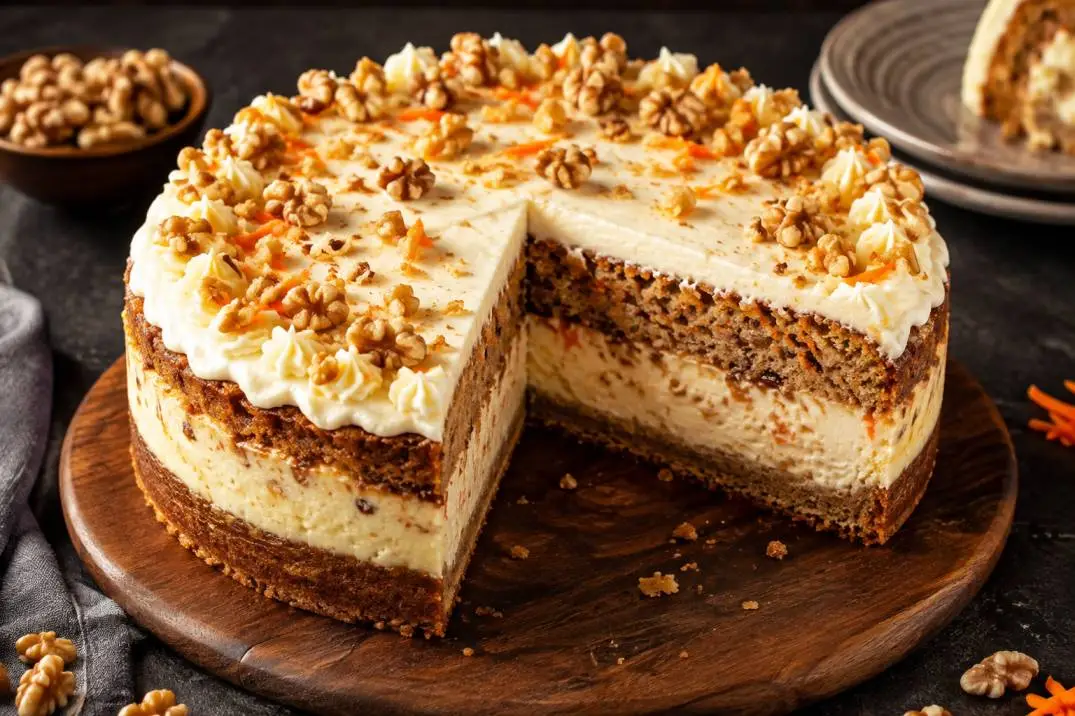
  4. Layer and swirl. Pour 1½ cups of the carrot cake batter into the bottom of the prepared pan. Drop spoonfuls of the cheesecake batter over top, using about a quarter of the total cheesecake batter. Spoon the remaining carrot cake batter over that layer, then finish with the rest of the cheesecake batter dropped on top in spoonfuls — don’t smooth it flat, the pockets are what create the swirl.
  5. Bake. Bake for 1 hour, or until the cake is set and no longer jiggles in the centre. Let cool, then cover and refrigerate for at least 1 hour.
  6. Make the frosting. In a medium bowl, cream together the cream cheese, butter, icing sugar, vanilla, and reserved pineapple juice until smooth.
  7. Frost and chill. Frost the top of the chilled cheesecake, then cover and refrigerate overnight before slicing — the extra chilling time is what lets the layers fully set and makes for clean slices.

Frequently Asked Questions

Is carrot cake cheesecake good?
Yes — the tangy cheesecake layer balances the sweet, spiced cake, which is why the combination works better than either dessert alone.

Why is it called “divorce carrot cake”?
It’s an internet nickname tied to a viral story about a couple’s divorce settlement involving a carrot cake recipe — it has no bearing on the recipe itself.

Which is healthier, cheesecake or carrot cake?
Neither has a clear edge. Both rely heavily on sugar, fat, and eggs; portion size affects the nutritional impact more than which dessert you choose.

Can I make a no-bake carrot cake cheesecake?
Yes, for the cheesecake layer — use full-fat block cream cheese and gelatin or whipped cream to set it, then pair it with a separately baked cake layer, since the cake portion can’t be made without an oven.

What are common no-bake cheesecake mistakes?
Using low-fat cream cheese and not chilling long enough are the two biggest culprits behind a cheesecake layer that won’t set.

Does cream cheese frosting go on carrot cake?
Yes — it’s the traditional pairing, and the tang is essential to balancing the cake’s sweetness and spice.

What’s a common carrot cake mistake?
Frosting the cake before it’s fully cooled, which melts the frosting into the crumb instead of letting it sit on top.

Final Thoughts

Carrot cake cheesecake isn’t a novelty mashup — it’s a genuinely well-engineered dessert once you understand why the pairing works: contrast in texture, contrast in flavour, and a frosting that ties both halves together. Whether you go the classic baked route above or a lighter no-bake cheesecake layer for a warm-weather bake, the technique matters more than the shortcut you choose.

Try the recipe this weekend, and if you run into a cracked cheesecake layer or a cake that won’t release from the pan, drop a comment — I’ll help you troubleshoot it before your next attempt.