
Red velvet cheesecake has a cult following of its own, proving that combining these two dessert icons is more than just a passing trend. Every bakery seems to call its version something special these days, but true red velvet cheesecake has specific technical markers behind it — and knowing them is the difference between recognizing the real thing on a menu and just taking a label at face value.
As a pastry chef, the questions I hear most about this dessert are about whether it’s genuinely a “thing,” whether a box cake mix can shortcut the process, and what makes the version at The Cheesecake Factory specifically taste the way it does. This guide covers all of it, plus gives you a full recipe.
Key Takeaways
- Red velvet cheesecake is a genuinely established dessert, not a novelty — it typically layers red velvet cake with a plain cheesecake filling rather than flavoring the cheesecake itself red velvet.
- A box cake mix works well for the red velvet layers, making this a reasonable shortcut without sacrificing much quality.
- The Cheesecake Factory’s version specifically layers red velvet cake with their Original cheesecake and finishes with cream cheese frosting — it’s a cake-cheesecake hybrid, not a cheesecake alone.
- Red velvet’s signature flavor comes from a small amount of cocoa powder plus a buttermilk-vinegar reaction, not from food coloring alone.
- Full recipe and an FAQ built from real reader questions are below.
Is Red Velvet Cheesecake Actually a Real Thing?
Yes, and there are two genuinely distinct ways it’s built. One version layers or stacks red velvet cake with a plain vanilla cheesecake, then finishes the whole thing with cream cheese frosting, since that frosting is already the traditional pairing for red velvet cake on its own. The other version skips the cake layers entirely and colors a portion of the cheesecake filling itself with cocoa powder and red food coloring, swirling it through a plain filling in a chocolate cookie crust — closer to a marbled cheesecake than a cake-cheesecake hybrid. Both are legitimate; they’re just different desserts wearing the same name.
As for who makes it — plenty of bakeries and home bakers do, but The Cheesecake Factory’s version is the one most people are picturing when they ask about it, largely because of how widely available and recognizable it’s become.
Can You Use Box Cake Mix to Make Red Velvet Cheesecake?
Yes, and it’s a genuinely reasonable shortcut rather than a compromise. A red velvet box cake mix, prepared according to package directions, works well as the cake layers in this dessert — the technical difficulty in a hybrid like this sits more with the cheesecake portion (getting it to bake evenly and cool without cracking) than with the cake layers, so there’s little reason to make red velvet cake from scratch if a good box mix is available. The same applies to cupcake versions — a box mix red velvet cupcake with a small cheesecake layer baked into the base or swirled through the batter works just as well as a from-scratch approach.
If you want a no-bake version, that generally means skipping the baked cheesecake layer entirely in favor of a whipped cream cheese filling, still paired with baked (or box-mix) red velvet cake layers — the cake portion still needs an oven, but the cheesecake element doesn’t.
What Makes The Cheesecake Factory’s Version Special?
Their Ultimate Red Velvet Cake Cheesecake layers red velvet cake with their Original cheesecake, then covers the whole thing in cream cheese frosting, with white chocolate as a finishing touch on some versions. What sets it apart from a simpler homemade attempt isn’t a secret ingredient so much as scale and structure — full cake layers sandwiching a full cheesecake layer, rather than a thin cheesecake swirl through cake batter. It’s genuinely more cake-and-cheesecake-stacked than cheesecake-with-a-red-velvet-flavor, which is worth knowing if you’re trying to replicate it rather than just make something red velvet-adjacent.
As for what makes red velvet cake taste the way it does in the first place — the flavor comes from a small amount of cocoa powder combined with a buttermilk-and-vinegar reaction, which gives it a subtle tang and slightly softer crumb than a standard vanilla or chocolate cake. The red color is traditionally from food coloring, though a genuine cocoa-and-buttermilk reaction historically produced a reddish tint on its own with certain types of cocoa, which is part of where the cake’s origin story comes from.
What Makes Cheesecake in General So Difficult?
Cheesecake’s reputation as one of the harder desserts to get right comes down to its custard-based structure having very little tolerance for error compared to cake batter — overmixing, overbaking, or cooling too quickly all show up immediately as cracks or a sunken centre. In a hybrid dessert like this one, that difficulty is somewhat offset by the cake layers doing a lot of the visual and structural work, so a cheesecake layer with a minor crack matters less here than it would in a standalone cheesecake, since it ends up sandwiched between cake and frosting anyway.
The Recipe: Swirled Red Velvet Cheesecake
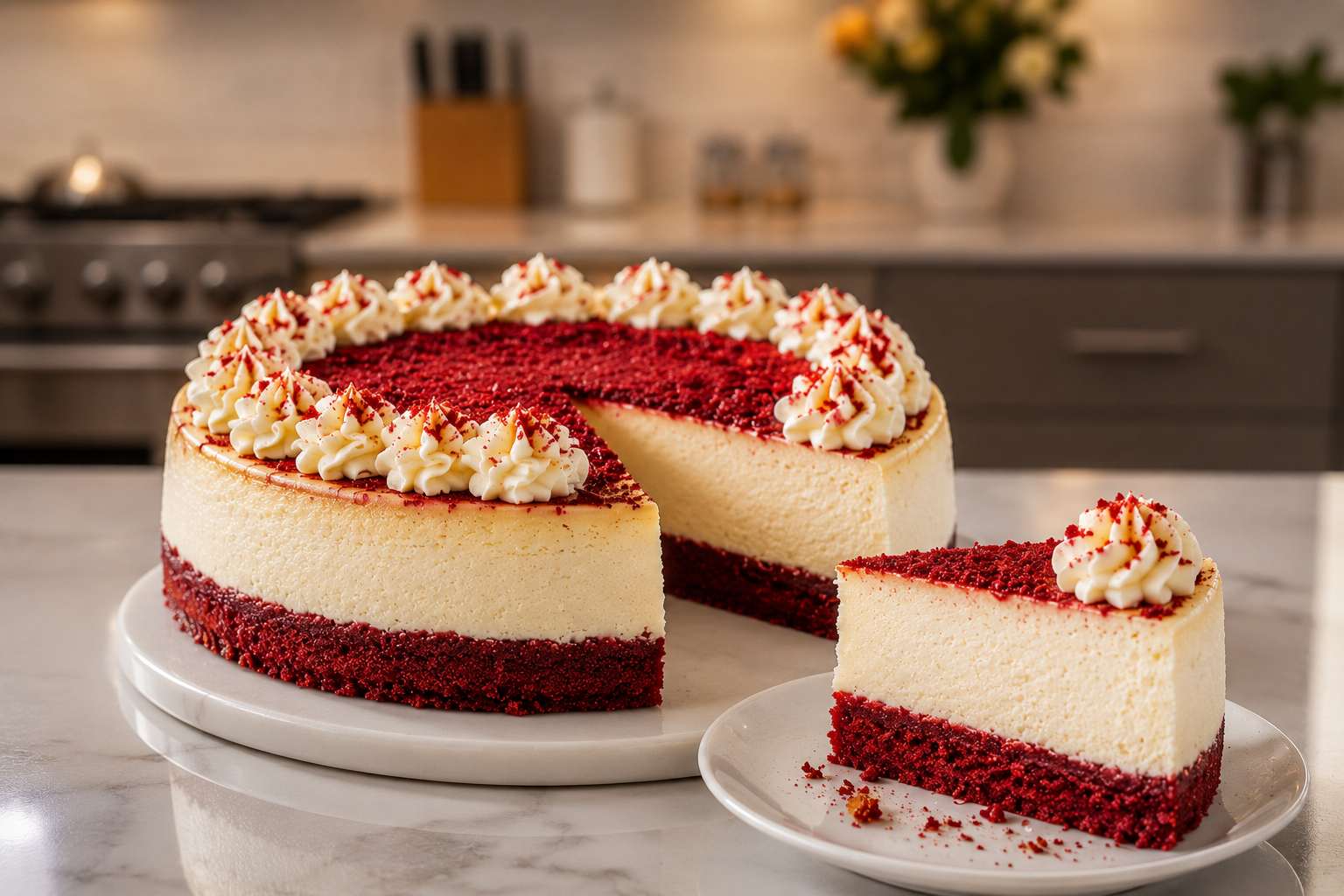
Red Velvet Cheesecake
Ingredients
Method
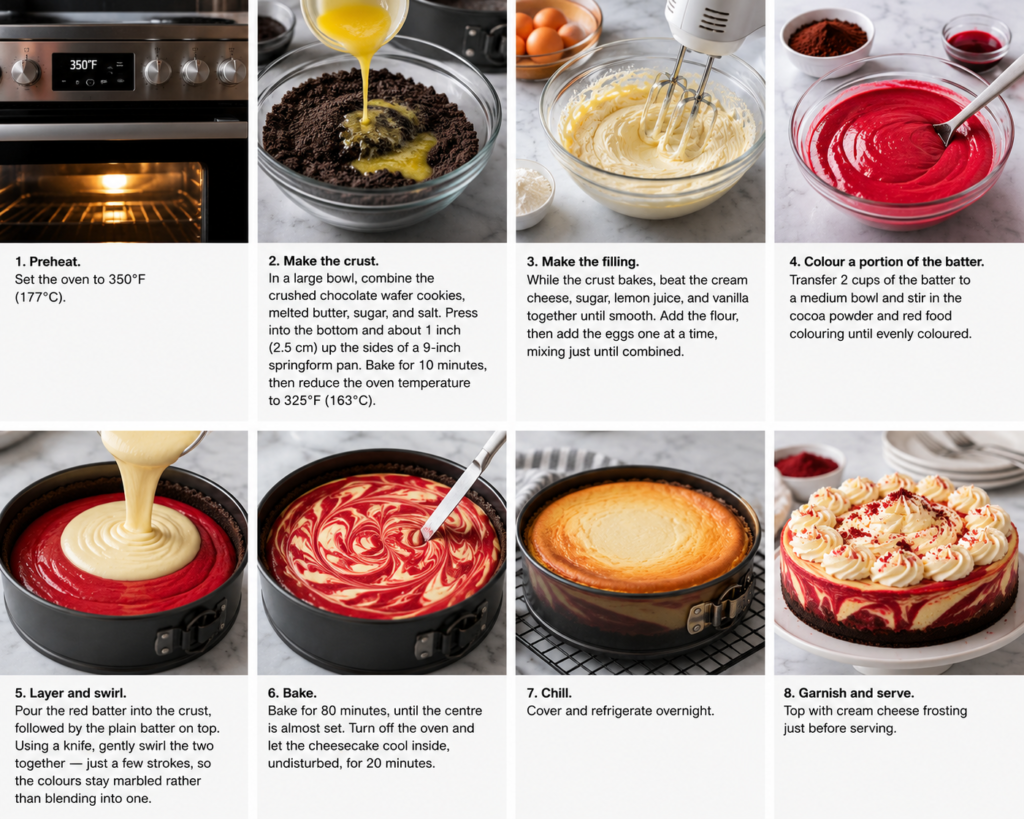
- Preheat. Set the oven to 350°F (177°C).
- Make the crust. In a large bowl, combine the crushed chocolate wafer cookies, melted butter, sugar, and salt. Press into the bottom and about 1 inch (2.5 cm) up the sides of a 9-inch springform pan. Bake for 10 minutes, then reduce the oven temperature to 325°F (163°C).
- Make the filling. While the crust bakes, beat the cream cheese, sugar, lemon juice, and vanilla together until smooth. Add the flour, then add the eggs one at a time, mixing just until combined.
- Colour a portion of the batter. Transfer 2 cups of the batter to a medium bowl and stir in the cocoa powder and red food colouring until evenly coloured.
- Layer and swirl. Pour the red batter into the crust, followed by the plain batter on top. Using a knife, gently swirl the two together — just a few strokes, so the colours stay marbled rather than blending into one.
- Bake. Bake for 80 minutes, until the centre is almost set. Turn off the oven and let the cheesecake cool inside, undisturbed, for 20 minutes.
- Chill. Cover and refrigerate overnight.
- Garnish and serve. Top with cream cheese frosting just before serving.
Frequently Asked Questions
Does Cheesecake Factory make red velvet cheesecake?
Yes — their Ultimate Red Velvet Cake Cheesecake layers red velvet cake with their Original cheesecake, finished with cream cheese frosting.
Is there such a thing as red velvet cheesecake?
Yes — it’s a well-established dessert, typically built by layering red velvet cake with a plain cheesecake filling rather than flavoring the cheesecake itself.
Which boxed cake mix is best for red velvet cake?
Any standard red velvet box mix works well here — the technical challenge in this dessert is the cheesecake layer, not the cake, so a good box mix is a reasonable shortcut.
Can I make red velvet cheesecake cupcakes using box cake mix?
Yes — prepare the box mix as directed and add a small cheesecake layer or swirl to each cupcake before baking.
Can you give me a recipe for a no-bake red velvet cheesecake?
Pair baked red velvet cake layers with a whipped, no-bake cream cheese filling instead of a baked cheesecake layer — the cake portion still needs an oven, but the cheesecake element doesn’t.
What makes Cheesecake Factory’s red velvet special?
Full cake layers sandwiching a full cheesecake layer, rather than a thin swirl — it’s closer to a cake-cheesecake hybrid than a flavored cheesecake.
What is the secret to red velvet cake?
A small amount of cocoa powder combined with a buttermilk-and-vinegar reaction, which gives it a subtle tang and softer crumb than standard chocolate or vanilla cake.
Final Thoughts
Red velvet cheesecake earns its popularity by combining two desserts that already work — whether you build it as a layered cake-and-cheesecake stack or, as in this version, swirl the red velvet flavour directly through the filling itself. Either approach delivers the same striking colour contrast and familiar cocoa-and-cream-cheese pairing that makes red velvet recognizable in the first place.
Give the recipe a try this week, and if your swirl blends into a solid colour instead of staying marbled, leave a comment — it almost always comes down to over-swirling, and I’m happy to help you get a cleaner marble next time.